
Pug


Make Pug one of your prefered breed on this website

Pedigrees


  Click ancestor to traverse. Double-click to view pedigree page

Forums


The History

Wolf's Lil Joe born on Jul 18, 1965AM CAN CH Wolf's Lil Joe
Wolf's Kauffee Royal Rose born on Jun 12, 1962AM CH Wolf's Kauffee Royal Rose

Sample photo gallery


3 Photo Galleries

Sample Pug pedigrees

  • Myojo Boldheart
  • Karimao's Olympic Venus
  • Ozman Clemdark Shany
  • Bickford,s Frank
  • Bickford,s George
  • Puggens Wilfred
  • School House Pocket Watch
  • HUGAPUGS SAIL AWAY TO CORAL BAY
  • Carikaiza New Kelly
  • Sasquehanna Sheffield For Show
  • Wrinklewoods Peking Peas
  • Xoe’s Cassius Clay
  • CORAL BAY'S SUPER HERO
  • Bagira
  • Kalkowood'S Power Rock

Description

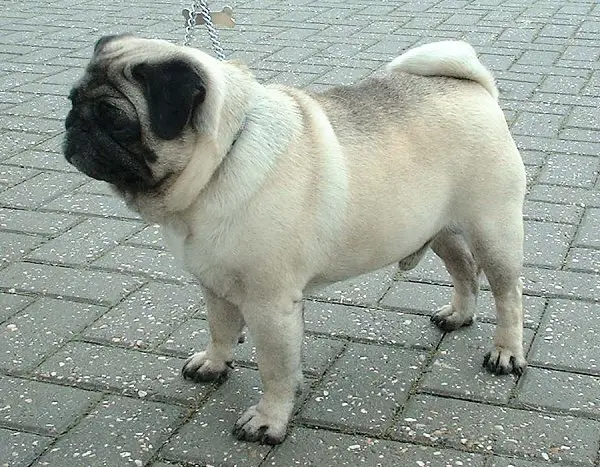
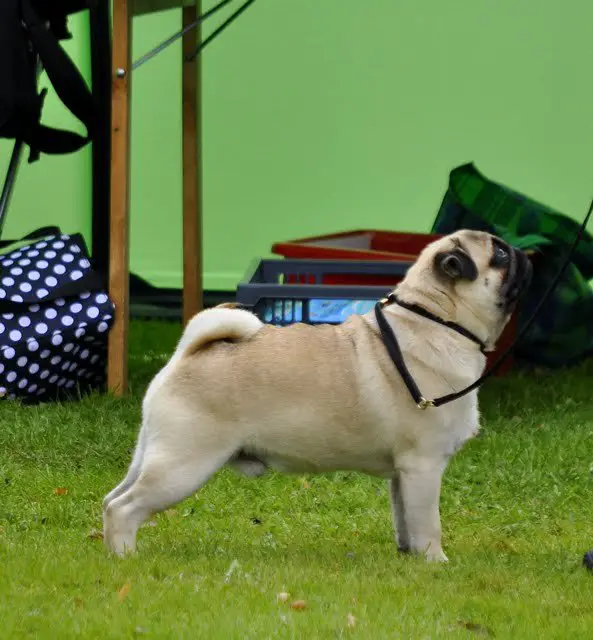
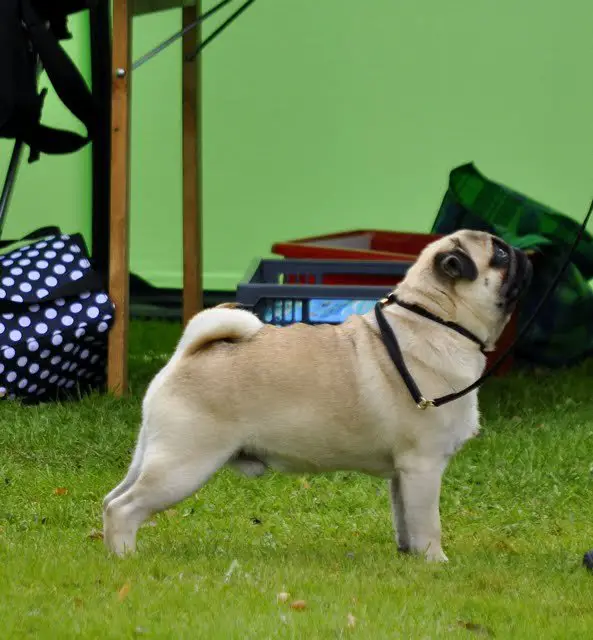
A black pug puppyThe breed is often summarized as multum in parvo ("much in little"), describing the pug's remarkable personality despite its small size. While the pugs appearing in eighteenth century prints tended to be long and lean, modern breed preferences are for a square, cobby body, a compact form, a deep chest, and well-developed muscle. Pugs have two distinct shapes for their ears, "rose" and "button". "Rose" ears are smaller than the standard style "button" and are folded with the front edge against the side of the head. Breeding preference goes to "button" style pugs. The legs are very strong, straight, of moderate length, and are set well under. The shoulders are moderately laid back. The pasterns are strong, neither steep nor down. The feet are neither so long as the foot of the hare, nor so round as that of the cat; well split-up toes, and the nails black. The lower teeth normally protrude further than their upper, meeting in an under-bite.

Coat and color

Fawn pugs and black pugs are similar in every way, except the color of their coats.Their smooth, glossy coats can be fawn, apricot fawn, silver fawn, or black. The markings are clearly defined. The trace is a black line extending from the occiput to the tail. The tail normally curls tightly over the hip.

Temperament

Strong willed but rarely aggressive, the pug is suitable for families with children. The majority of the breed is very fond of children and sturdy enough to properly play with them. They can be quiet and docile but also vivacious and teasing depending on their owner's mood.

History

Origins

Moscow, Pushkin Museum of Fine ArtsPugs were bred to adorn the laps of the Chinese sovereigns during the Shang dynasty (before 400 BCE). They were known as "Lo-Chiang-Sze" or "Foo" (ceramic foos, transmogrified into dragon, with their bulging eyes are similar in appearance to the pug). References to pug-like dogs have been documented as early as 551 BCE by Confucius, who described a type of "short mouthed dog". The lo-sze or early pug may have been the predecessor of today's modern Pekingese. The pug's popularity spread to Tibet, where they were mainly kept by Buddhist monks, and then went on to Japan, and finally Europe. The exact origins of the pug are unknown, as Emperor Qin Shi Huang, the first Emperor of China, destroyed all records, scrolls and art related to the pug at some point during his reign which lasted between 221 and 210 BCE.

Chinese fu dogs, also called lion dogs or fo dogs, were thought of as guardians and statues of them were placed outside temples. The faces of these statues resemble Oriental short-faced dogs, such as the Japanese chin Tibetan Spaniel, Lhasa apso, Pekingese and the pug.

16th and 17th centuries

The breed was imported to Europe in the 16th century by the Dutch East India Company. It is said to have become the official dog of the House of Orange in 1572 after a pug named Pompeysaved the life of the Prince of Orange by alerting him to the approach of assassins. A pug travelled with William III and Mary II when they left the Netherlands to ascend to the throne of England in 1688. During this period the pug may have been bred with the old type King Charles Spaniel, but in any event the modern English Toy/King Charles Spaniel emerged with pug characteristics.

The breed eventually became popular in other European countries. Pugs were painted by Goya in Spain, and in Italy they were dressed in matching jackets and pantaloons while riding up front with the coachman on a private carriage. They were used by the military to track animals and people, and were also employed as guard dogs.

18th and 19th centuries

The popularity of the pug continued to spread in France during the eighteenth century. Before her marriage to Napoleon Bonaparte, Joséphine had her pug Fortune carry concealed messages to her family while she was confined at Les Carmes prison. The pet was the only recipient of visiting rights. The pug was also well known in Italy. In 1789, a Mrs. Piozzi wrote in her journal, "The little pug dog or Dutch mastiff has quitted London for Padua, I perceive. Every carriage I meet here has a pug in it."

The English painter William Hogarth was the devoted owner of a series of pugs. His 1745 self-portrait, which is now in London's Tate Gallery, includes his pug Trump.

In nineteenth century England, the breed flourished under the patronage of the monarch Queen Victoria. Her many pugs, which she bred herself, included Olga, Pedro, Minka, Fatima and Venus. Her involvement with the dogs in general helped to establish the Kennel Club, which was formed in 1873. Victoria favoured apricot and fawn colors, whereas the aristocrat Lady Brassey is credited with making black pugs fashionable after she brought some back from China in 1886.

In paintings and engravings of the 18th and 19th centuries, they usually appeared with longer legs and noses, and with cropped ears. The modern pug's appearance probably appeared after 1860 when a new wave of pugs were imported directly from China. These pugs had shorter legs and the modern style pug nose. Ear cropping was outlawed in 1895.

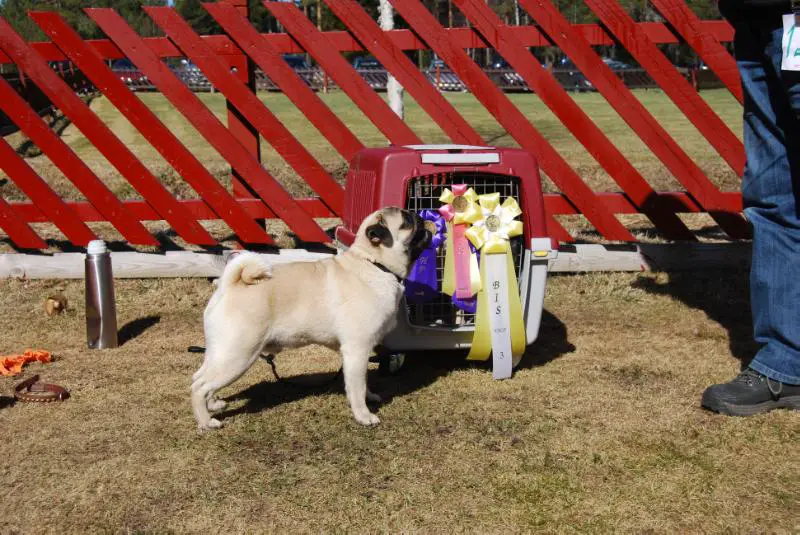
The pug arrived in the United States during the nineteenth century (the American Kennel Club recognized the breed in 1885) and was soon making its way into the family home and show ring. In 1981 the pug Dhandys Favorite Woodchuck won the Westminster Kennel Club show in the United States, the only pug to have won since the show began in 1877. The World Champion (Best in Show or BIS) at the 2004 World Dog Show held in Rio de Janeiro, Brazil was a pug, Double D Cinoblu's Masterpiece. The Pug Dog Club of America was founded in 1931 and recognized by the AKC that same year.

Health problems

Pugs have large eyes and a wrinkledface with a long tongue. Improper care of the wrinkles may sometimes cause adverse health effects.Since pugs lack longer snouts and prominent skeletal brow ridges, they are susceptible to eye injuries such as proptosis, scratched corneas and painfulentropion. They also have compact breathing passageways, leaving many unable to breathe properly or efficiently regulate their temperature throughevaporation from the tongue. A pug's normal body temperature is between 101 °F (38 °C) and 102 °F (39 °C). If the temperature rises to 105 °F (41 °C), oxygen demand is greatly increased and immediate cooling is required. Should the temperature reach 108 °F (42 °C), the internal organs begin to break down at a cellular level, which can lead to severe long term health issues or even death.

Pugs living a mostly sedentary life can be prone to obesity, though this is avoidable with regular exercise and a healthy diet. Pugs are also prone to breathing difficulties caused by a constricted windpipe and flat face. The median life span of pugs is 11 years.

An investigative documentary carried out by the BBC found significant inbreeding between pedigree dogs, with a study by Imperial College, London, showing that the 10,000 pugs in the UK are so inbred that their gene pool is the equivalent of only 50 individuals.

Serious issues


Pugs can suffer from necrotizing meningoencephalitis (NME), also known as pug dog encephalitis (PDE), an inflammation of the brain and meninges. NME also occurs in other small-breed dogs, such as the Maltese and Chihuahua. There is no known cause or cure for NME, although it is believed to be an inherited disease. Dogs usually die or are euthanised within a few months of onset of clinical signs. Signs typically appear between 6 months and 7 years of age.

This breed, along with other brachycephalic dogs (e.g., boxers, bulldogs), are also prone to hemivertebrae. The screwtail is an example of a hemivertebrae, but when it occurs in other areas of the spine it can be devastating, causing such severe paralysis that euthanasia is a serious recommendation. The condition occurs when two parts of the spinal vertebrae do not fuse properly whilst a young pug is still growing, resulting in pressure on the spine.

Common conditions

Care must be taken to prevent a pug from becoming overweight.Eye prolapse is a common problem among other brachycephalic breeds and can be caused by trauma to the head or neck, such as an injury or using a tight leash instead of a harness. While it can be fixed by returning the eye back to its socket by the owner, a visit to the vet is required to check for eye and eye socket injuries. If the prolapse happens on a regular basis, the pug might require surgery to save its eye. In a worst case scenario, the dog may have the eye removed.

As pugs have many wrinkles in their faces, owners clean inside the creases to avoid irritation and infection. Hip dysplasia affected 63.8% of pugs in a survey performed by the Orthopedic Foundation for Animals; they were ranked second worst affected by the condition out of 157 breeds tested.

The pug, like other short-snouted breeds, has an elongated palate. When excited, they are prone to "reverse sneezing". During this phenomenon, the dog will quickly (and seemingly laboriously) gasp and snort. The veterinary name for this is Pharyngeal Gag Reflex. This is caused by fluid or debris getting caught under the palate and irritating the throat or limiting breathing. "Reverse sneezing" episodes are usually not harmful to the pug and resolve themselves. Massaging the dog's throat or covering its nose in order to make it breathe through its mouth can often shorten episodes.

Pugs are one of several breeds that are more susceptible to Demodectic mange, also known as Demodex. This condition is caused by a weakened immune system, and it is a minor problem for many young pugs. This causes them to catch diseases much more easily than regular dogs do. It is easily treatable, but some are especially susceptible and will present with a systemic form of the condition. This vulnerability is thought to be genetic, and breeders avoid breeding dogs who have had this condition. Inbreeding is also a known cause for these problems.

Sample Pug classifieds

  • 4 & HALF MONTHS MALE PUG :
  • NICE PUG PUPPIES :
  • OUTSTANDING PUG PUPPY :
  • EXTRA ORDINARY PUG PUPPY :
  • AWESOME PUG PUPPY :
  • AWESOME PUG PUPPIES :
  • EXTRA ORDINARY 4 MONTHS MALE PUG PUPPY :
  • 3 MONTHS MALE PUG PUPPY :
  • AWESOME PUG PUPPY :
  • VERY NICE MALE PUG PUPPY :
  • EXCELLENT MALE PUG FROM AMERICAN CHAMPION LINES:
  • Pug Puppy For Sale
  • EXTRA ORDINARY PUG PUPPY :
  • 3 months male pug :
  • 5 months female pug puppy :


Pug breeders over the world

Click on a marker to get breeders information
Double click to zoom or use the slider
Do NOT follow this link or you will be banned from the site!